Anyone who has moved flat in New York knows the routine. The date goes in the calendar months ahead, everyone agrees it matters enormously, and three weeks out you are still eating dinner off the boxes.
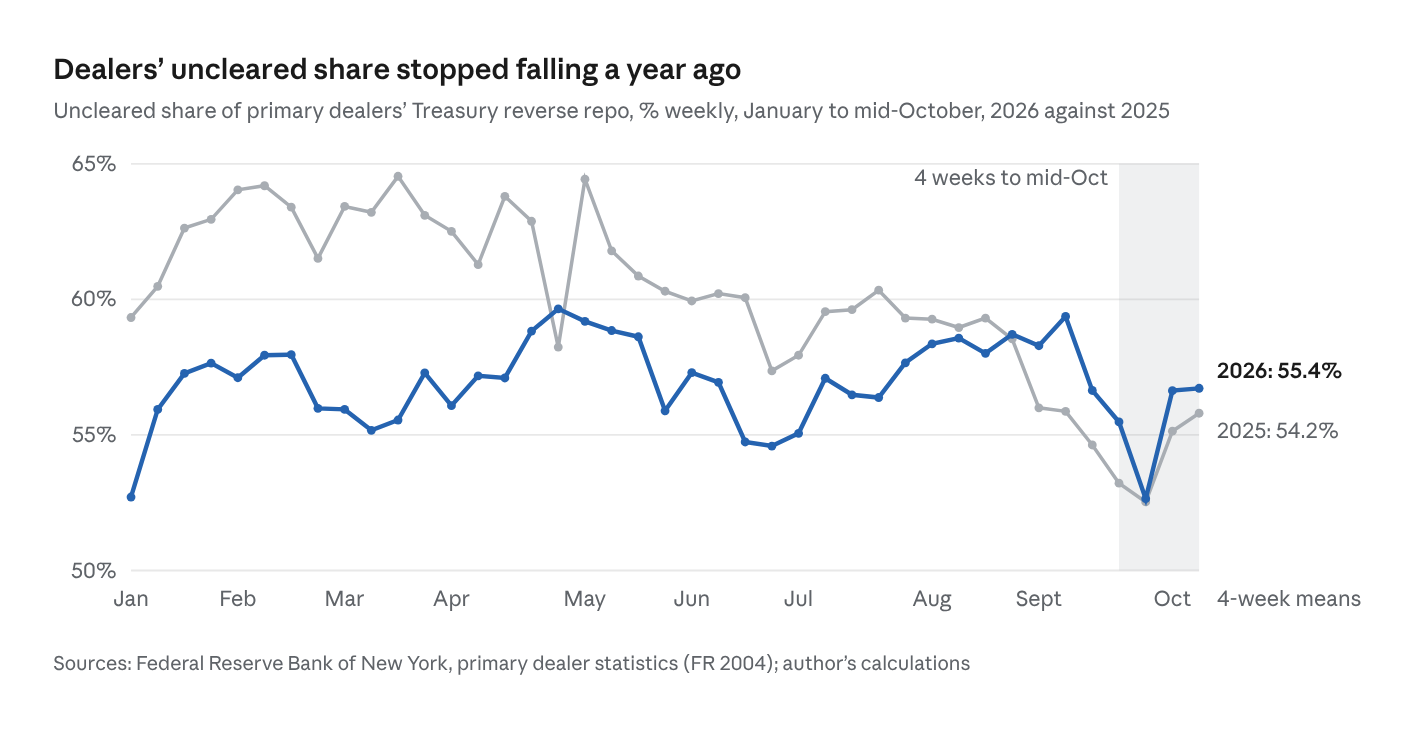
Treasury repo is at that stage, only with more weeks left and fewer boxes packed. On 30 June 2027, 247 days from now, the SEC’s clearing rule reaches the repo market. In the four weeks to 14 October, 55.4 per cent of the big dealers’ cash lending against Treasuries was still uncleared, by the New York Fed’s weekly data. In the same weeks of 2025 it was 54.2 per cent. In dollars the uncleared pile grew, from $1.44tn to $1.55tn. Lending through the clearinghouse’s sponsored service went from $0.59tn to $0.58tn.¹
Box count: unchanged.
A quick refresher for anyone with a life. In cleared repo, a central counterparty, the Fixed Income Clearing Corporation (FICC), stands between borrower and lender. Uncleared, or bilateral, repo is a private deal between the two, at whatever haircut they agree. The SEC’s rule requires clearing wherever at least one side is a direct member of a clearing agency. In practice that puts the obligation on the dealers.
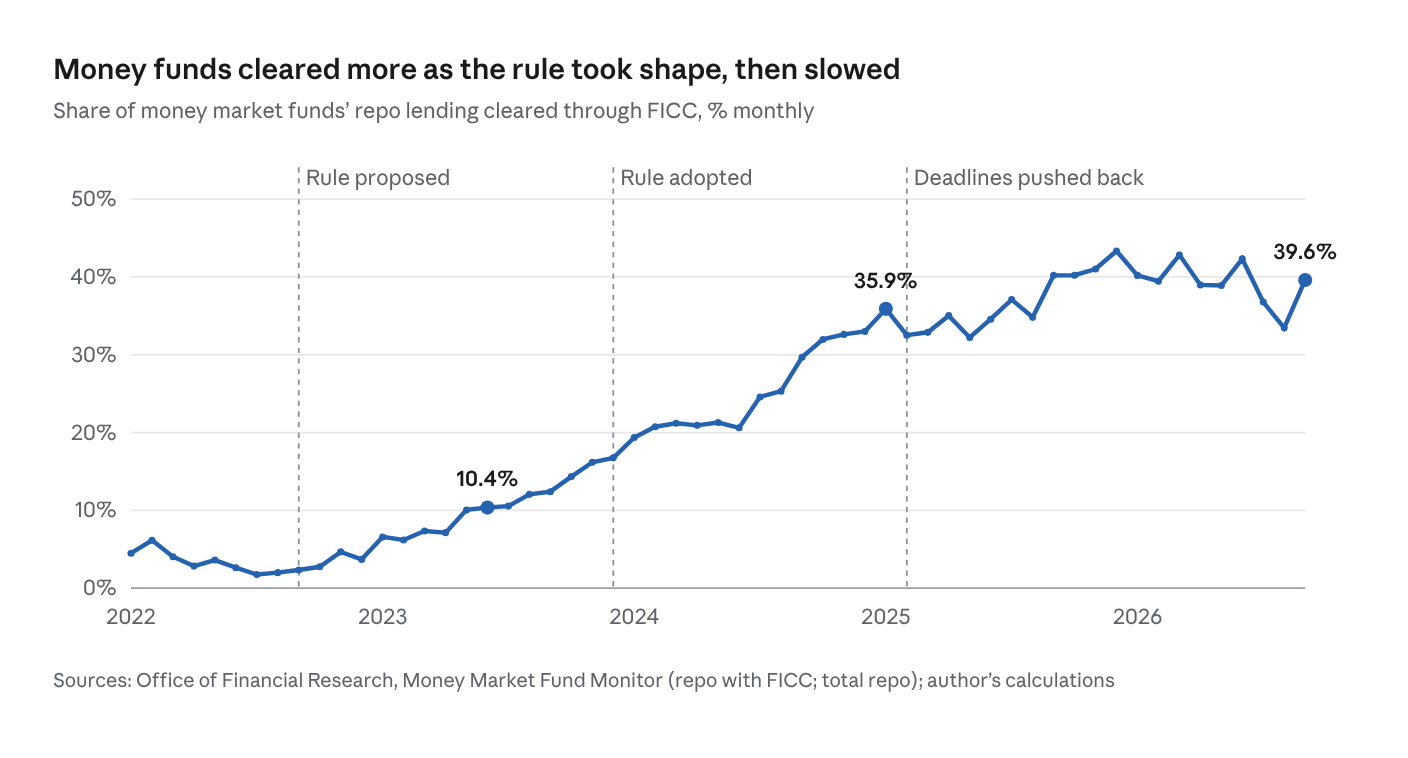
The lenders, at least, packed early. The share of money market funds’ repo lending that went through FICC sat between 2 and 6 per cent through 2022. It started climbing once the SEC proposed the rule that year, reaching 10.4 per cent by June 2023 and 35.9 per cent by January 2025. The rule was only adopted on 13 December 2023, so the funds were moving well before anything was final.²
Then in February 2025 the SEC pushed both deadlines back a year, to 31 December 2026 for cash trades and 30 June 2027 for repo. Every fit I tried shows the funds’ move slowing after that, by 6 to 10 points a year, to about 2 points a year since. The share stood at 39.6 per cent in September. The extension may explain the slowdown. So may saturation, since the easy boxes get packed first. The data can’t tell the two apart.
The van at the kerb
The rest of the market got as far as the pavement. The Office of Financial Research, the Treasury’s financial-stability arm, tracks the cleared share of the repo the rule actually targets. It peaked at about 72 per cent at the end of 2025, then fell back to about 62 per cent in early 2026. Across all Treasury repo it went from a peak of 53 per cent to about 46 per cent.
Part of that peak is a year-end effect tied to banks’ G-SIB surcharge, which is measured at year-end. Tidy for the inspection, then back to normal. One quarter is a short run, and the OFR’s own word for it is a plateau.
Even the packing list is still being argued over. Industry groups asked the SEC to clarify and widen the exemption for trades between affiliates, one of the “critical issues” in the February 2025 extension.
The boxes that won’t close
Every move has a few boxes nobody wants to tape. In repo they belong to hedge funds. The OFR finds they clear their cash lending (ie reverse repo) at significantly lower rates than their borrowing. Those reverse repos often carry negative haircuts, and about 68 per cent are netted against other repos. The New York Fed reckons hedge funds’ repo with dealers was about 30 per cent cleared in late 2025.
Price is roughly a wash. An earlier OFR brief finds funds pay about the same rate cleared or bilateral, and most funds active in Treasuries already use the cleared segment. The costs sit in margin and in tenor. Meanwhile, by the New York Fed’s count, 75 per cent of uncleared bilateral Treasury repo carries a zero haircut.
No margin! Well, not until June.
My reading is that a fund borrowing at zero haircut has every reason to stay bilateral until the day it can’t. That is an inference from the incentives, not something the data show fund by fund.
The inventory
Then there’s the paperwork. Amendments to Form PF, the private-fund filing behind the OFR’s hedge-fund data, were adopted in February 2024. Their compliance date has been pushed back four times. It now falls on 1 July 2027, the morning after the repo deadline. The SEC’s rule on who counts as a dealer fared worse: a Texas court vacated it on 21 November 2024.
None of this means the uncleared trades are hidden. The OFR collects data on uncleared bilateral repo from the large dealers. Supervisors can see them. The public can’t.
Why bother
A flat line eight months out leaves two ways to arrive. One is a scramble next spring, as funds that post no margin today start posting it, all at roughly the same time. That would land on the corner of the market that borrows most: hedge funds’ repo borrowing was $3.38tn in June, as I noted last time. The other is a second extension. After the first one the move slowed, for reasons the data can’t pin down.
Neither outcome is a crisis. Both are better planned for in October than discovered in June. The cash deadline comes first, on 31 December, the same date the G-SIB surcharge is measured. Happy new year.
Next time
The move needs cash to run on. Twice in eight years, repo got tight when banks’ reserves at the Fed fell to about a tenth of the federal debt held by the public, at very different dollar amounts. That could be a rule of thumb worth having, or a coincidence. The next piece weighs the two.
On current form the dealers will still be carrying boxes down the stairs at midnight on 30 June. The inventory clerk arrives at nine the next morning.
- Primary dealers only. The series is broader than the rule: it includes trades between affiliates and general-collateral trades the rule may not reach, so it does not measure the rule’s progress. It dips every year-end, so the comparison is always with the same weeks a year earlier; over 8-, 13- and 26-week windows the gap stays within 1.5 points. Weeks with suppressed figures are dropped.
- The 2022 starting point was chosen after looking at the data. It fits better than the December 2023 adoption date.